
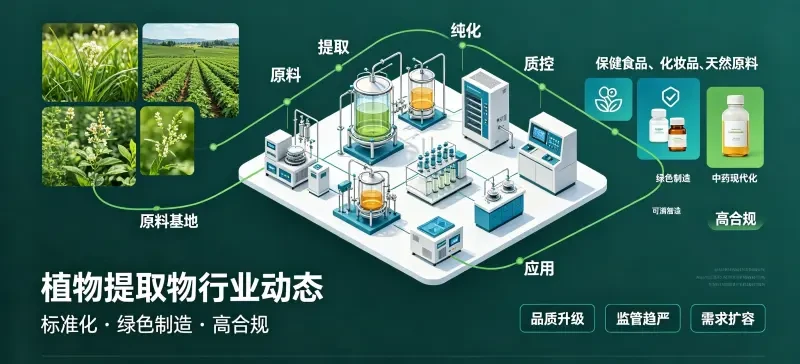
Entering the fourth quarter of 2026, China's plant extract industry is undergoing a triple upgrade in policy standardization, production standardization, and diversification of application scenarios. With the full implementation of new national standards, continuous improvement of regulatory frameworks for new ingredients in cosmetics and health foods, and accelerated adoption of green biomanufacturing technologies, the natural plant extract industry has officially entered a new stage of high-quality development. The sector is moving away from extensive competition toward high purity, high compliance, full traceability, and precise functional positioning.
1. National standards fully implemented: Industry enters the "Era of Strong Standards"
2026 marks a pivotal year for the standardization of the plant extract industry. The newly implemented national standard, "Technical Specification for Production Processes of Plant Extracts" (GB/T46671-2025), establishes unified requirements across production workflows, extraction methods, impurity control, quality inspection, and storage and transportation. This resolves long-standing industry pain points, including inconsistent processes, variable quality control, and the proliferation of non-standard products.
At the same time, regulatory oversight continues to tighten across pharmaceuticals, healthcare, and cosmetics:
1. The China National Institutes for Food and Drug Control has released the draft guidelines for defining new cosmetic raw materials, providing clear definitions regarding plant extract source parts, process changes, solvent substitutions, and varietal/subspecies differences. These measures aim to eliminate fake innovations and spurious new raw materials while significantly raising compliance standards.
2. Accelerate the establishment of a system for adopting national and industry standards for plant extracts in the health food sector, promoting the direct inclusion of well-defined, safe, controllable, and maturely processed plant active ingredients into the compliant raw material catalog.
3. The high-quality development plan for the Chinese medicine industry continues to be implemented, with policy support focused on standardized raw material bases, digital extraction production lines, and deep purification projects for active ingredients.
A series of overlapping policies mark the end of "low-price raw material competition" in the plant extract industry. Compliance, stability, and precise indicator accuracy are now core competitive advantages for companies.
2. Green manufacturing replaces traditional processes, optimizing both production costs and quality.
In the second half of 2026, leading industry players fully adopted green processes such as continuous countercurrent extraction, low-temperature membrane separation, supercritical extraction, and low-temperature drying/purification. Compared to traditional high-temperature decoction and crude alcohol extraction methods, these new intelligent manufacturing technologies have achieved three breakthroughs:
Higher retention of bioactive compounds: Low-temperature processing maximally preserves heat-sensitive components such as polyphenols, flavonoids, alkaloids, and peptides.
Stricter Impurity Control: Precision impurity removal and graded purification to significantly reduce ash, heavy metals, pesticide residues, and solvent residuals.
Lower energy consumption and emissions: Aligns with policies in biomedicine and green manufacturing, and meets audit standards for exports and premium clients.
Meanwhile, a digital quality control system is being widely adopted, enabling full-process data traceability from raw material acceptance, extraction, concentration, purification, and drying to finished product testing. This fully aligns with USP/EP standards, European Pharmacopoeia requirements, and domestic regulations for food-medicine homology and cosmetic ingredient compliance.
III. Downstream Demand Surges Across the Board; Multi-Scenario Applications Expand Continuously
The global and domestic plant extract market continued to grow steadily in 2026, driven by the rising consumer demand for natural, healthy, and additive-free products. The three core segments are experiencing strong demand:
1 Health Supplements and Functional Foods Sector
Demand for flavonoids, polyphenols, plant peptides, and herbal extracts continues to surge. Consumers are shifting from basic wellness to targeted functional benefits, driving a shortage of high-purity, standardized, and quantifiably effective plant ingredients.
2 Cosmetics Natural Ingredients Sector
Under new regulations, the volume of new ingredient filings continues to surge. Plant-based ingredients offering gentle anti-aging, soothing repair, and whitening hydration are becoming the R&D mainstream. Compliant, safe, low-irritation plant extracts are gradually replacing traditional synthetic raw materials.
3: Modernization of Pharmaceuticals and Traditional Chinese Medicine
Strong policy support is driving the modernization of China's traditional Chinese medicine (TCM) industry. Plant-based refined extracts have become the core raw material for TCM patent medicines, hospital-prepared formulations, and innovative TCM drug development, continuously expanding opportunities in high-end and formulation-focused segments.
IV. Reshaping Industry Competition: From Price Wars to Quality and Compliance
As standards are implemented and regulations tighten, numerous small workshops and non-compliant factories are accelerating their exit, driving continued consolidation in the industry. The logic of market competition has fundamentally shifted:
Margins on low-end, crude products continue to shrink.
Standardized high-purity extracts, customized formulation ingredients, and compliance filing support services are emerging as new growth drivers.
The company holds significant advantages with its own raw material base, proprietary purification processes, comprehensive testing capabilities, and compliance with both domestic and international pharmacopoeia standards.
The core barriers in the industry of the future will center on: process stability, impurity control capabilities, compliance qualifications, traceability and testing systems, and custom R&D capabilities.
Outlook for the Industry in Q4
From Q4 of 2026 to 2027, the plant extract industry will continue to show three key trends:
1. Standardization and normalization: Comprehensive implementation of quality control standards across all product categories and processes; non-standard products are gradually exiting the mainstream market.
2. Refined Functionality: Transitioning from crude extracts to single compounds and high-purity active ingredients for more precise efficacy metrics.
3. Global Market Expansion: Rising export share of high-quality domestic plant extracts, supporting global dietary supplement, cosmetic, and pharmaceutical ingredient supply chains.
As a core upstream ingredient in the wellness industry, natural plant extracts will maintain strong growth momentum, driven by policy tailwinds, technological advancements, and rising consumer demand. This positions them as a promising emerging sector under the new quality productive forces framework.